|
 The
The SID Space Weather Monitor program is an education project to build
and distribute inexpensive ionospheric monitors to students around
the world. The monitors detect solar flares and other ionospheric
disturbances. Two versions of the monitor exist - the original SID instruments, and a new, lower-cost SuperSID. The
The SID Space Weather Monitor program is an education project to build
and distribute inexpensive ionospheric monitors to students around
the world. The monitors detect solar flares and other ionospheric
disturbances. Two versions of the monitor exist - the original SID instruments, and a new, lower-cost SuperSID.

Earth's ionosphere
reacts strongly to the intense X-ray and ultraviolet radiation
released by the Sun during a solar flare. By using a receiver
to monitor the signal strength from distant VLF transmitters,
and noting unusual changes as the waves bounce off the ionosphere,
students around the world can directly monitor and track these
Sudden Ionospheric Disturbances (SIDs).
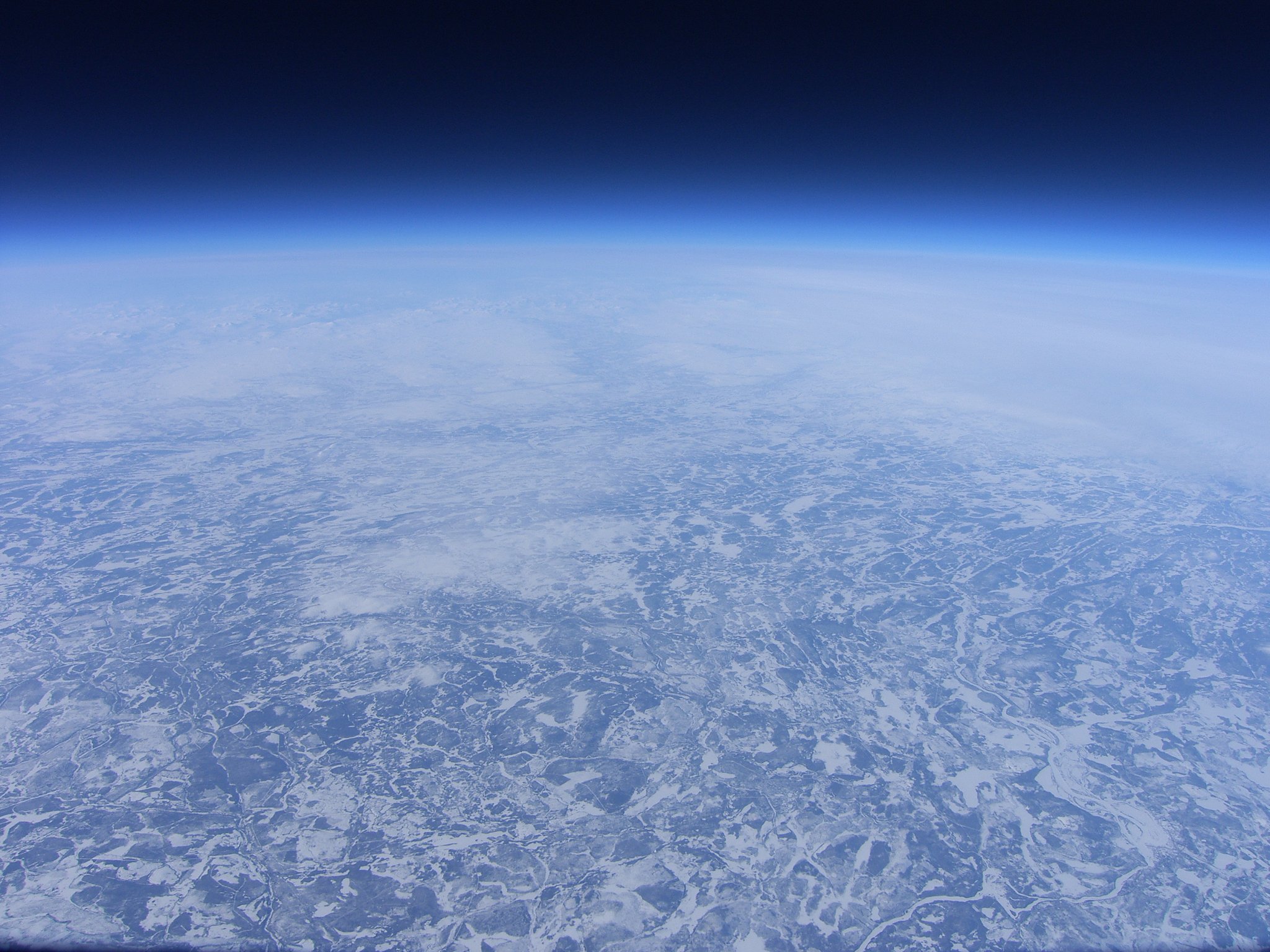
 Earth
from the low ionosphere
Earth
from the low ionosphere
Photo courtesy Jorgen Hedin |
Stanford's
Solar Center and local educators have developed inexpensive
SID monitors that students can install and use at their local
high schools. Students "buy in" to the project by building
their own antenna, a simple structure costing less than $10 and
taking a couple hours to assemble. Data collection and analysis
is handled by a local PC, which need not be fast or elaborate.
Because there are VLF transmitters scattered around the world,
the monitors can be placed virtually anywhere there is access
to power.
Stanford is providing a centralized data repository
where students can deposit and extract data.
The Society of Amateur Radio Astronomers (SARA)
has taken over distribution and support of the project and also maintains a
Yahoo SuperSID group
where students can exchange and discuss data.
Featured
The SID Monitor Program
This presentation is designed to describe the SID project and offer an introduction to the relevant science for a potential mentor audience. The
presentation could also be adapted to be given to high school students who have received a SID monitor.
The SID packages passes
NASA Product Review with "Outstanding" ranking!
NASA Cover Letter and Explanation
One review stated "This might be the most well put together resource I have ever reviewed!"
Read our article
Distributing space weather monitoring
instruments and educational materials worldwide for IHY 2007: The AWESOME and SID project
in Advances in Space Research (COSPAR)
Map of SID sites worldwide
List
of SID Monitors and Sites (Excel format)
List
of SuperSID Monitors and Sites (Excel format)
List of VLF transmitters:
AWESOME's
List
Lionel Loudet's List
SMETER's List
|
|
The
United Nations Office for Outer Space Affairs and
the United Nation's International Space Weather Initiative
both designated our Space Weather Monitors as supported projects for the
International
Heliophysical Year (IHY) and afterwards.
One of our SID monitors is on display in the rotunda of the United Nations building in
Vienna, Austria. We have placed over 900 monitors
throughout the world!
|  |
Image
Credits: Earth image courtesy of NASA.
Earth from the lower ionopshere courtesy Jorgen Hedin and Michael
Erneland, taken from an atmospheric balloon high about Rovaniemi,
Finland.
|